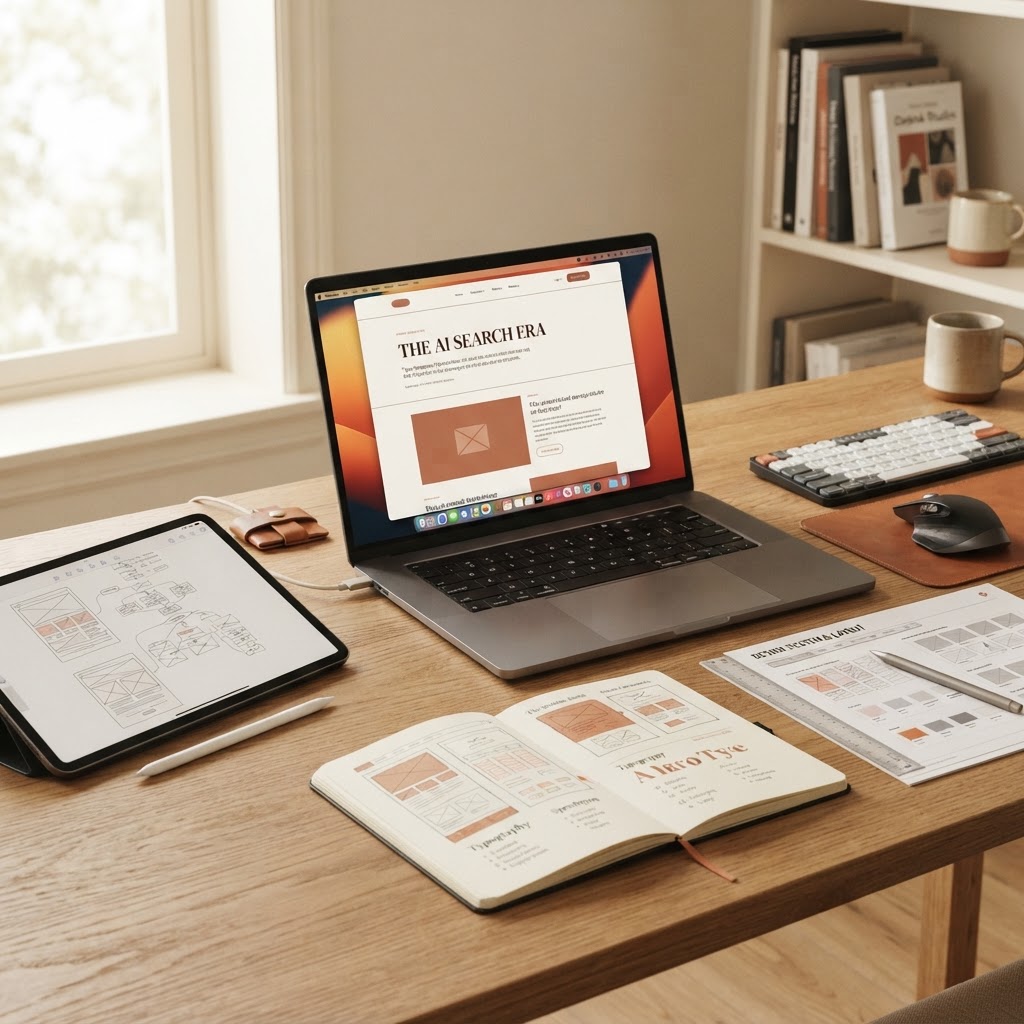
The web is getting louder and more interchangeable at the same time. AI can produce a respectable-looking homepage in minutes, website builders can assemble a launch in an afternoon, and templates have never been more polished. That is exactly why established brands should be more careful, not less.
For an established company, the website is not a disposable asset. It is a brand environment, a sales surface, a publishing system, and increasingly a machine-readable source for AI search. In that context, the real question is not whether a template can work. It is whether a template can protect brand equity, support growth, and outperform the cost of looking generic.
The short answer: established brands should choose bespoke web design in 2025 because it delivers better long-term ROI than templates across authority, conversion, performance, content operations, and differentiation. A quiet, editorial site does not merely look refined. It makes the brand easier to trust, easier to navigate, easier to cite, and easier to scale.
Why bespoke web design outperforms templates for established brands
Templates are built to be broadly acceptable. Established brands need to be specifically credible.
That difference matters more in 2025 than it did five years ago for a few reasons:
- Brand sameness is now a business risk. Many modern templates share the same layout patterns, spacing systems, motion styles, and stock visual logic. They make different companies feel oddly interchangeable.
- AI-generated content rewards clarity and originality. If a brand site looks and reads like everything else, it becomes harder for both people and machines to understand what makes it worth citing.
- Performance and structure now affect discovery beyond classic SEO. Fast, well-structured pages are easier for AI systems to crawl, interpret, summarize, and trust.
- Established brands have more to lose. A founder-led startup can survive a generic site for a season. A mature brand with reputation, press history, product depth, or premium positioning cannot.
The ROI of bespoke web design is not just a prettier interface. It comes from five durable advantages:
- Stronger brand authority through original art direction and restraint
- Higher quality engagement through better hierarchy, readability, and flow
- Better conversion performance through tailored messaging and page structure
- Improved Lighthouse score and AI search visibility through cleaner engineering
- Lower total cost over time when the content system matches the business
Across 27 years of client work since 1998, one pattern has remained steady: the more established the brand, the more valuable design restraint becomes. Loud sites often compensate for weak positioning. Strong brands can afford to be quiet.
What “quiet” web design actually means
Quiet web design is not empty design. It is not sterile minimalism, and it is certainly not design without personality.
It is editorial design applied to the web: clear hierarchy, deliberate spacing, disciplined typography, thoughtful image use, and a strong sense of pacing. It removes friction without removing character.
Minimalist web design builds brand authority by signaling control
A cluttered template usually reveals itself in small ways: too many card styles, inconsistent spacing, decorative motion that adds no meaning, oversized UI elements, competing calls to action, and content blocks stacked because the builder made them available.
That visual noise has a cost. It suggests that the brand is following the software rather than directing it.
By contrast, minimalist web design brand authority comes from selectivity:
- Fewer layout patterns used more consistently
- Clear visual priority for the most important message
- Strong negative space around headlines, imagery, and proof points
- Interfaces that feel composed rather than assembled
- Navigation that respects user intent instead of exposing every possible option
People read restraint as confidence. On the web, authority often looks like less because less leaves room for meaning.
For established brands, this matters because visitors are not evaluating the site only for usability. They are also asking, often subconsciously: Is this company precise? Is it credible? Does it have taste? Does it know what matters?
Quiet design answers those questions before the first sales conversation ever happens.
How custom typography and art direction improve engagement and conversion
Typography and art direction are often dismissed as finishing touches. For premium and established brands, they are closer to infrastructure.
Custom typography shapes trust, pace, and memory
The type system on a website controls more than style. It controls how quickly a user can orient, how comfortably they can read, what feels important, and what stays in memory.
A bespoke type system can improve conversion because it creates:
- Better readability, which keeps users in long-form case studies, product pages, and thought leadership content
- Stronger hierarchy, which reduces decision fatigue on dense pages
- Distinct brand recall, especially when typography is paired with a disciplined spacing system
- Appropriate tone, whether the brand needs to feel precise, warm, technical, luxurious, or assured
This is where custom typography conversion rate discussions often get oversimplified. Typography does not convert on its own. What it does is reduce hesitation. It makes the offer easier to absorb, the message easier to trust, and the entire experience feel more considered.
Art direction prevents the “template effect”
Art direction is the difference between having images on a page and having a point of view.
Templates usually treat media as interchangeable blocks. Bespoke design treats imagery, cropping, scale, contrast, and rhythm as part of the narrative. That matters because users do not experience pages as isolated components. They experience tone.
Strong art direction can improve engagement by:
- Guiding the eye toward proof, product detail, or differentiation
- Creating a distinctive visual rhythm that holds attention longer
- Making photography, illustration, and motion feel native to the brand
- Supporting premium pricing by making the experience feel intentional
For established brands, the practical takeaway is simple: if the site’s visual system could be swapped with a competitor’s in an afternoon, it is not doing enough work.
Why a 100/100 Lighthouse score matters for AI search visibility
A 100/100 Lighthouse score is not a magic ranking button. Search engines do not award medals for perfect audits. But for Lighthouse score AI search visibility, the principles behind that score matter more than ever.
AI search systems, answer engines, and crawlers prefer pages that are easy to fetch, easy to parse, and easy to interpret. That is where Generative Engine Optimization becomes practical rather than theoretical.
Generative Engine Optimization begins with machine-readable quality
Generative Engine Optimization means structuring a site so AI systems can accurately understand, extract, summarize, and cite its content. A site that scores highly in Lighthouse tends to support that goal because it usually has:
- Fast load times and low render delay
- Clean semantic HTML
- Good accessibility practices
- Stable layout with minimal visual shift
- Clear internal linking and heading structure
- Fewer bloated scripts and plugin conflicts
These qualities help both human users and machine agents. A slow, unstable, builder-heavy page may still look acceptable in a design review, but it can be fragile in the environments that now shape discovery.
Why established brands should care
When AI systems summarize an industry, recommend vendors, or cite sources, they favor pages that are authoritative and technically legible. A bespoke site with strong performance, clean content structure, and clear authorship stands a better chance of being represented accurately.
That is why a push toward 100/100 matters. Not because perfection itself creates traffic, but because the engineering discipline required to reach it tends to produce:
- Better crawl efficiency
- Lower bounce from speed-related frustration
- Cleaner structured content for summaries and answers
- More reliable indexing across important pages
- Greater confidence in the site as a source
In short: a high Lighthouse score is not the goal. It is evidence that the site has been built with enough care to compete in both classic SEO and AI-mediated discovery.
The ROI of headless CMS vs a website builder
For established brands, the headless CMS vs website builder decision should be made on operating cost, not launch cost.
A builder almost always looks cheaper at the start. Over three years, that is often no longer true.
When a website builder makes sense
A builder can be perfectly rational for:
- Simple brochure sites
- Single-market businesses
- Small content libraries
- Teams with minimal integration needs
- Short time horizons
If the site rarely changes, has a limited page count, and does not need to feed multiple channels, a builder may be enough.
Where headless CMS delivers better ROI
A headless CMS usually requires more planning and a higher upfront investment, but the return shows up in the daily life of the business.
For established brands, the main advantages are:
- Structured content that can be reused across web, mobile, email, sales tools, and AI-friendly knowledge surfaces
- Editorial governance with cleaner workflows, permissions, and approval processes
- Better performance because the front end is not carrying theme and plugin debt
- Design freedom without fighting the assumptions of a builder
- Easier integration with CRMs, product data, localization tools, and analytics systems
- Longer useful life because content and presentation are decoupled
The real bespoke web design ROI often appears in avoided costs:
- Fewer rebuilds caused by platform limits
- Less plugin maintenance and fewer conflicts
- Shorter publishing time for complex content
- Cleaner migration path when the brand grows or reorganizes
- Reduced dependency on a specific theme ecosystem
A practical rule: if the website is part of a larger content operation, not just a marketing brochure, headless usually earns its keep.
Why bespoke design differentiates a brand from AI-generated content
AI is very good at producing competent averages. That raises the value of specificity.
A site built from AI-assisted copy and common template blocks may function, but it rarely develops a point of view. The result is a subtle erosion of distinction: familiar claims, familiar structure, familiar rhythm.
Established brands should care because audiences are getting better at spotting synthetic sameness, even when they cannot name it directly.
Bespoke design makes authority visible
Originality on the web does not require visual theatrics. It usually comes from craft:
- A content model designed around the brand’s actual expertise
- A layout system tuned to the brand’s voice and sales process
- Typography and image treatment that feel unmistakably owned
- Case studies and proof structured for real reading, not block-filling
- Writing that sounds edited rather than generated
This is where quiet design becomes commercially useful. It gives the brand a recognizable signature without resorting to gimmicks.
AI can produce pages. It cannot easily produce editorial judgment.
That judgment is what separates a site that gets scanned and forgotten from a site that feels credible enough to revisit, reference, and share.
How established brands should evaluate the decision in practice
The choice between bespoke and template should not be framed as taste versus budget. It should be framed as expected return.
A practical decision checklist
Established brands should lean toward bespoke if three or more of these are true:
- The brand competes on trust, expertise, or premium positioning
- The site supports multiple audiences, regions, or product lines
- The company publishes regularly and needs better editorial workflow
- The current site is slow, plugin-heavy, or difficult to update cleanly
- The business depends on organic search, thought leadership, or AI visibility
- The existing template makes the brand look interchangeable with competitors
Metrics worth tracking before and after redesign
To judge ROI honestly, measure more than vanity metrics. Useful indicators include:
- Conversion rate on high-intent landing pages
- Time to publish and update key pages
- Engagement depth on case studies and long-form content
- Organic visibility for branded and non-branded terms
- Referral and citation patterns from AI search products
- Lighthouse performance, accessibility, and SEO scores
- Lead quality, not just lead volume
This is where many established brands miscalculate. They compare the price of a bespoke site to the price of a template. They should be comparing the price of bespoke design to the cost of diluted brand authority, slow publishing, missed search visibility, and another redesign in 18 months.
The real answer for 2025
Established brands should choose bespoke web design over templates in 2025 because the website has become too important to outsource to generic patterns.
A bespoke site does four things templates struggle to do consistently:
- It expresses authority without clutter
- It improves conversion through tailored hierarchy and narrative flow
- It supports AI search visibility through performance and structure
- It creates a content system that remains useful as the business grows
That is the return. Not novelty. Not indulgence. Not design for its own sake.
Just a quieter site that works harder.
Frequently Asked Questions
Is minimalist web design always better for established brands?
Not always, but restraint usually ages better than visual excess. The goal is not emptiness; it is clarity, hierarchy, and a level of polish that matches the brand’s maturity.
Does a 100/100 Lighthouse score guarantee better rankings or AI citations?
No. It does, however, indicate strong technical hygiene, which supports speed, accessibility, crawlability, and machine readability. Those factors make a site easier for both users and AI systems to trust and process.
When does a headless CMS pay for itself?
Usually when a brand manages a growing content library, multiple teams, several channels, or complex integrations. If the site is a living publishing system rather than a static brochure, headless often reduces friction enough to justify the higher upfront cost.